Node installer
The TrinityX node installer, lpart, provisions a node from two settings held in Luna: the install mode, which says what should happen to the node's operating system, and the disk layout, which describes the node's disks. Both are set on the group and can be overridden per node. A node that runs from RAM needs no disk layout at all; a node installed to disk is driven entirely by it. Hand-written partition scripts are no longer needed for a local disk, a mirror or a RAID set.
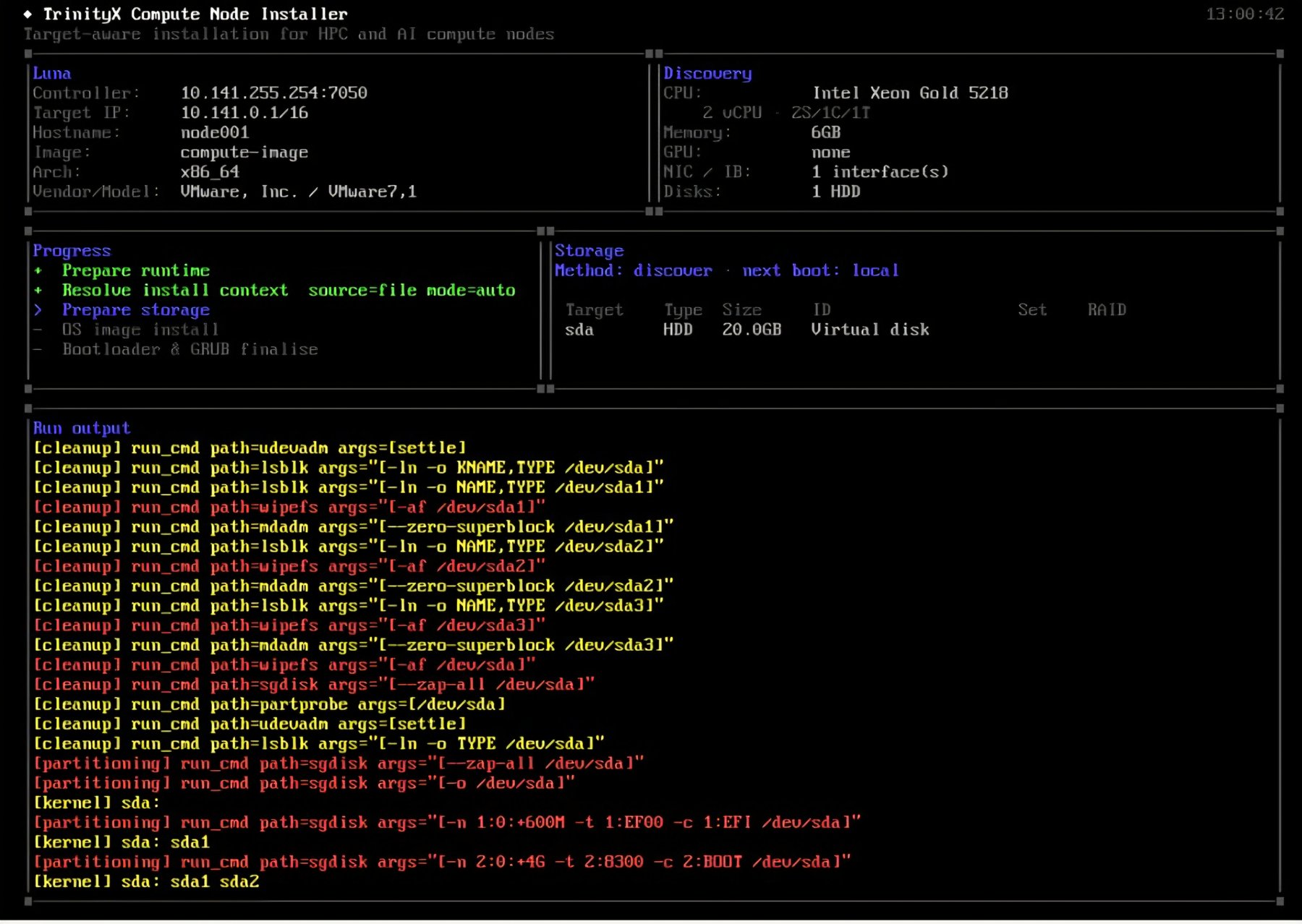
The installer shows its progress on the node's console: the node's identity as Luna knows it, the hardware it discovered, the phases it runs through, the storage it resolved and the commands it runs.
Install mode
The mode is the headline decision. auto is the default and does the sensible thing without
supervision; the other modes exist for when you want to be explicit.
install_mode |
What happens | Destroys data? |
|---|---|---|
auto (default) |
Install if the disk is blank, refresh if it is healthy, repair if it is broken, leave data alone. If no disk layout is declared, run from RAM. | Only the blank or broken parts |
sync |
Refresh the OS on the existing layout. If the disk is not as expected, stop and report instead of wiping. | No |
full |
Wipe and reinstall from scratch. | Yes, on purpose |
local |
Boot the OS already on the disk, fetch nothing. | No |
memboot |
Run the OS from RAM (diskless); mount local data sets if declared. | No |
sanitize |
Securely erase the node's disks, for handing the node to a new tenant. No install. | Yes, on purpose |
legacy |
Run the classic installer with the pre, part and post scripts, as before. | Per the scripts |
auto, sync, full and local use the disk layout. memboot consults it only for data
sets. sanitize and legacy ignore it.
# luna group change compute --install-mode auto
# luna node change node001 --install-mode full
What the modes guarantee:
- A data set is wiped only by an explicit
full, never byautoorsync. - A set marked
persistentis never partitioned, formatted or written by any mode exceptsanitize. It is only mounted. syncnever destroys existing data. On a broken or mismatched disk it halts.automay recreate the OS set, which carries no user data. A broken data set halts.- A declared OS layout that cannot be satisfied — no disks, too few, none matching — halts and reports. The node does not silently fall back to RAM.
Disk layout
A disk layout is a set of sets. A node has at most one OS set, where the system is installed, and any number of data sets for local storage. Each set says which disks to use and how to arrange them, and lists the volumes to create on them.
The layout is written in YAML (JSON is accepted too) and stored on the group or the node:
# luna group change compute --disklayout            # opens $EDITOR
# luna group change compute -qdl /root/layout.yaml  # loads a file
# luna group showdisklayout compute
# luna node showdisklayout node001
A layout set on a node replaces the group's layout as a whole; fields are never merged.
Choosing the disks
With selection: discover, the installer finds the disks at boot and matches them by tag and
size, so one group layout fits a fleet whose disks sit in different slots or differ in size.
Every disk is tagged automatically from what the kernel reports: rotary for a spinning disk,
ssd for any solid-state disk, and nvme in addition for NVMe disks. A match may combine:
tags: the disk must carry every tag listed;min_sizeandmax_size: either may be left out;model: the disk model name must contain this text.
An omitted match accepts any disk. From the matching disks the set takes as many members as
its RAID level needs (or the count given), smallest first.
With selection: manual you list the exact device paths under devices. Paths under
/dev/disk/by-path/ or /dev/disk/by-id/ are stable across reboots; /dev/sdX names are not.
A discovered set can be pinned: with save: true the first install writes the disks it
resolved back to the node as a manual layout, and every later boot reproduces exactly those
disks. Clearing the node's layout returns it to the group's recipe.
Arranging the disks
raid |
Arrangement | Disks | Gives you |
|---|---|---|---|
none (default) |
single disk | 1 | one disk, no redundancy |
0 |
stripe | 2 | speed, no redundancy |
1 |
mirror | 2 | redundancy |
5 |
single parity | 4 or 5 | capacity, survives one disk loss |
6 |
dual parity | 5 or more | capacity, survives two disk losses |
10 |
stripe of mirrors | 4 | redundancy and speed |
The OS set does not take parity RAID
An OS set uses 1, 2 or 4 disks withnone, 1, 0 or
10. RAID 5 and 6 are refused for the OS set, because the bootloader cannot reliably
boot a degraded parity array. Data sets take every level.
Volumes
A volume is one mountpoint within a set, backed by a provider of partition or lvm, with a
filesystem (vfat, xfs, ext4 or swap) and a size. The common OS volumes have defaults,
so they can be written as bare mountpoints:
| Mountpoint | Filesystem | Provider | Size |
|---|---|---|---|
/boot/efi |
vfat |
partition |
600M |
/boot |
xfs |
partition |
1G |
/ |
xfs |
lvm |
100% |
Any other mountpoint defaults to xfs on lvm and needs a size. A supplied value always
wins over a default.
A complete layout for one disk, found at boot, therefore reads:
version: 2
sets:
  - role: os
    match: {min_size: 20G}
    volumes: [/boot/efi, /boot, /]
luna group showdisklayout shows the layout with every default filled in, which is also what the
node receives. More shapes — mirrors, stripes, RAID data sets, persistent data next to a RAM
OS — are in Disk layouts: worked examples.
What the group's scripts must not do
The partscript and postscript of a group still run, before the installer's own partition and
post phases. The stock compute group's partscript mounts a tmpfs on /sysroot for diskless
booting; left in place on a group that installs to disk, it puts the installation in RAM and
nothing reports it. On a group or node that uses a disk layout, set both to a no-op:
# luna group change compute -qpart 'true' -qpost 'true'
Requirements and limits
- UEFI only. The installer writes GRUB in UEFI mode and registers the NVRAM boot entry, for x86_64 and aarch64 alike. Legacy BIOS and CSM are not supported and are refused.
- The image must carry the installer. The
lparttools ship with theluna2-clientpackage inside the image. When an image lacks them, the node reports the statusinstall.lpart_unavailableand falls back to the classic installer; the disk is then whatever the partscript produced. Update the client in the image, or setinstall_mode: legacyon the node to stop asking for it. - Validation happens twice. Luna rejects a malformed layout when it is stored — wrong
version, unknown field, bad value — and the node checks the topology rules (member counts,
the OS-set RAID restriction, a missing
/boot/efior/) before touching a disk.
Where things are on the node
The installer writes its logs to /tmp/install_files/logs/ during the install, one file per
tool and phase, and its resolved inputs to /tmp/install_files/runtime/. The console shows the
same commands as they run.